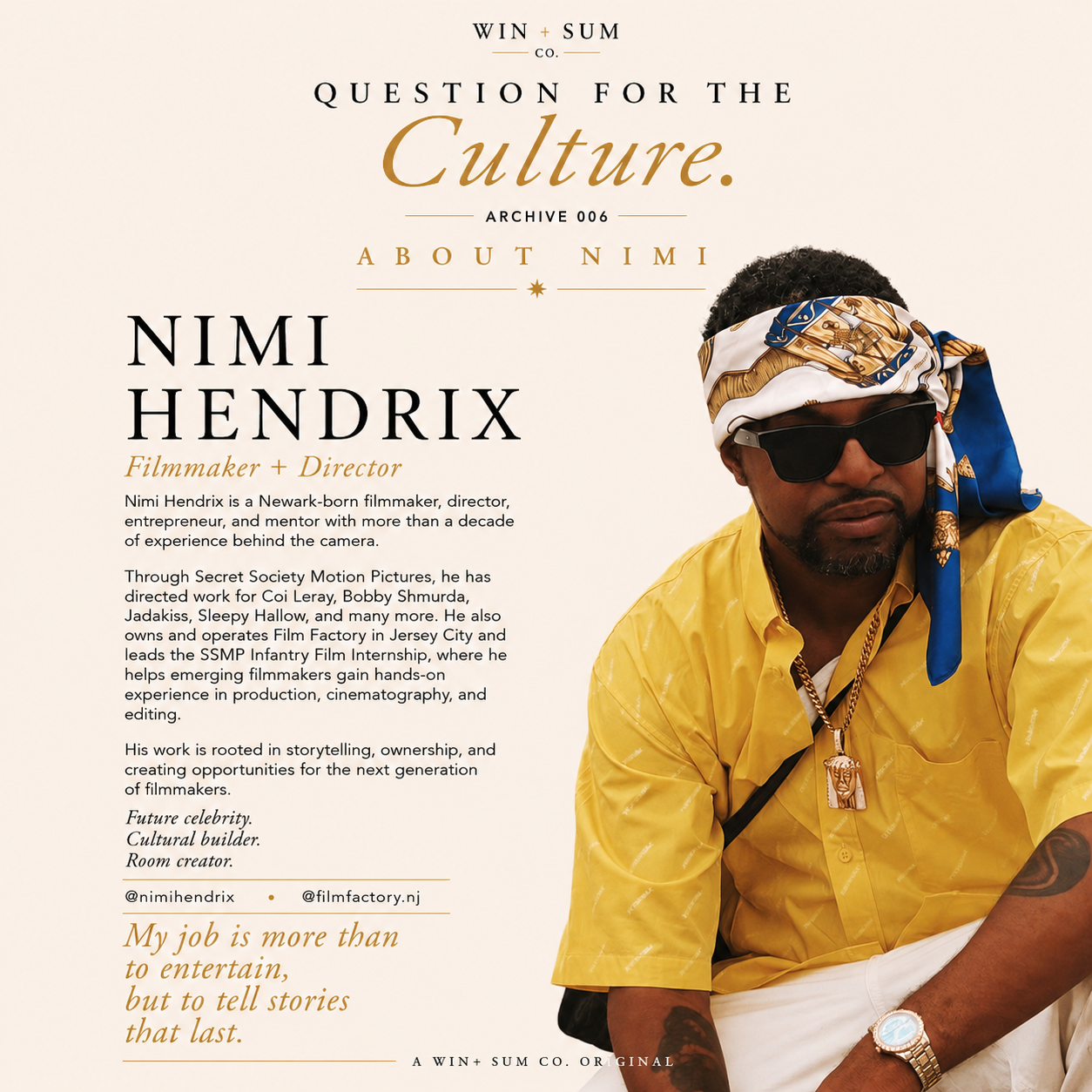
Question for the Culture
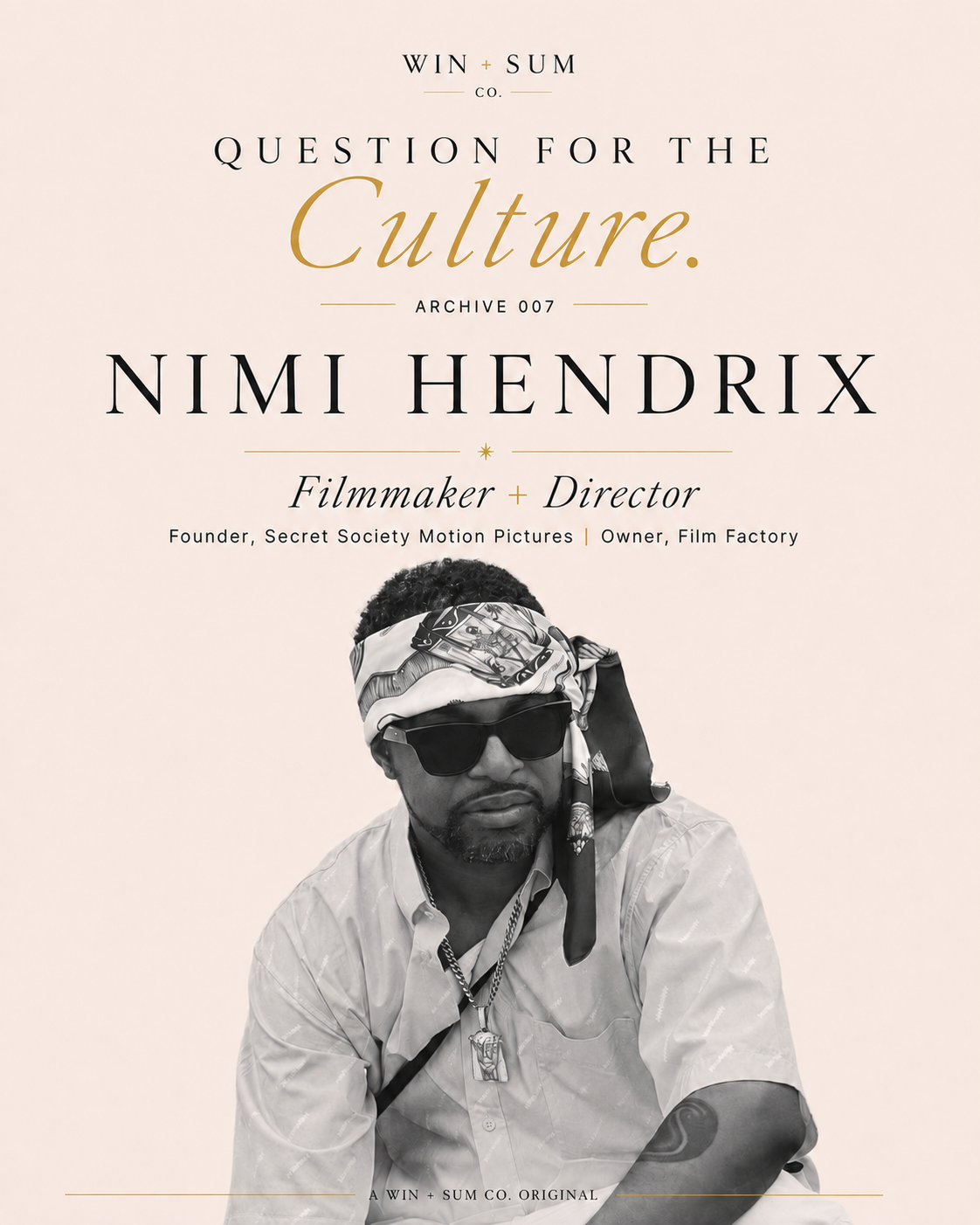
Nimi Hendrix
Filmmaker + Director · Founder, Secret Society Motion Pictures | Owner, Film Factory
Why Nimi Was Selected for Archive 007
Nimi was chosen because he is smack in the middle of the culture, behind the lens helping determine how some of the people moving hip-hop and R&B are seen.
He is behind the camera while culture is being made, documented, and remembered in real time.
His work moves between generations. From artists who helped shape the culture to artists shaping what it sounds and looks like now, his lens has captured people including Coi Leray, Remy Ma, Sleepy Hallow, Jadakiss, Bobby Shmurda, and others.
He is not watching these moments from the outside.
He is helping decide how we see them.
That matters to me.
Because visibility is not accidental.
Someone chooses the angle.
Someone decides what stays in the frame.
Someone captures the moment people may eventually remember as history.
His work has also been deeply connected to New Jersey. From building Secret Society Motion Pictures out of Newark to creating visual work rooted in the Jersey scene, his career has grown alongside the community that helped shape his eye.
His direction of Coi Leray's Players (DJ Smallz 732 Jersey Club Remix) helped bring Jersey culture directly into the visual language of the record and earned recognition through a 2023 BET Hip Hop Awards nomination for Best Hip Hop Video.
But the accolade is only part of why I chose him.
What pushed Nimi beyond simply being someone whose work I admired was the SSMP Infantry Film Internship.
Through the program, he gives emerging filmmakers hands-on experience in production, cinematography, and editing.
Real sets.
Real work.
Real proximity to an industry where getting close enough to learn can still be one of the hardest parts.
And while Nimi is helping document the generation in front of him, he is also creating access for the generation coming behind him.
He is helping shape what this era looks like while making room for someone else to pick up the camera next.
That made me curious about what responsibility feels like when your lens is this close to the culture.
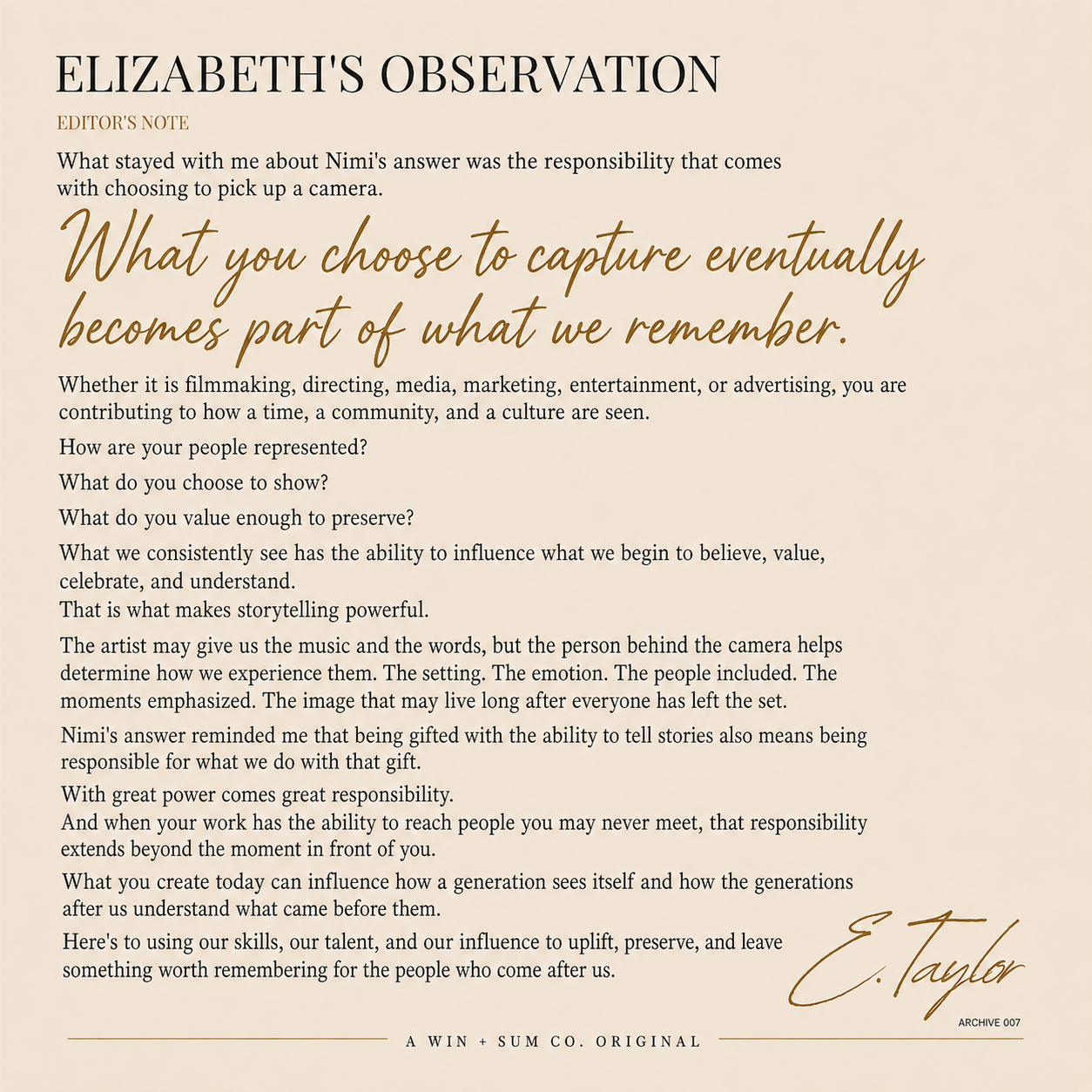
What you choose to capture eventually becomes part of what we remember.
The Question
A camera doesn't just record history—it decides what history gets remembered. As someone behind the lens, how has that responsibility changed the way you see your role in culture?
His Answer
“My job is more than to entertain, but to tell stories that last, have meaning, and create an impact.”
In becoming a filmmaker, I realized that my job is more than to entertain, but to tell stories that last, have meaning, and create an impact. Events and issues that I find important, I try to capture and use that as a way to communicate what I value, and what I think the viewer should remember about our time.
In the past I've had to decide between different paths and what kinds of stories to tell, and my approach usually takes me to the stories that I find more significant, to raise awareness on an issue I feel is important or to convey an emotion for others to relate to a group of people.
About Nimi